After Finitude by Quentin Meillassoux
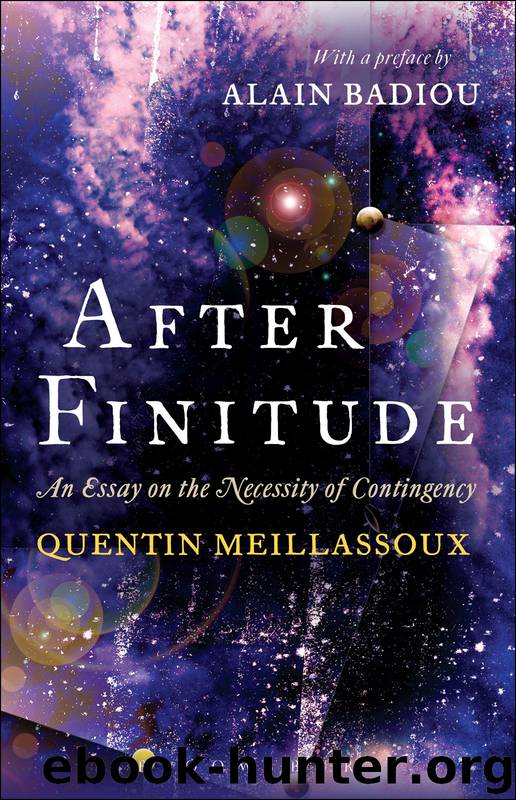
Author:Quentin Meillassoux
Language: eng
Format: epub
Publisher: Bloomsbury_Academic UK
Published: 2008-10-06T04:00:00+00:00
Philosophy is the invention of strange forms of argumentation, necessarily bordering on sophistry, which remains its dark structural double. To philosophize is always to develop an idea whose elaboration and defence require a novel kind of argumentation, the model for which lies neither in positive science – not even in logic – nor in some supposedly innate faculty for proper reasoning. Thus it is essential that a philosophy produce internal mechanisms for regulating its own inferences – signposts and criticisms through which the newly constituted domain is equipped with a set of constraints that provide internal criteria for distinguishing between licit and illicit claims.
Far from seeing in criticism a threat to its consistency, the examination of the determinate conditions for absolute unreason should strive to multiply objections, the better to reinforce the binding texture of its argumentative fabric. It is by exposing the weaknesses in our own arguments that we will uncover, by way of a meticulous, step by step examination of the inadequacies in our reasoning, the idea of a non-metaphysical and non-religious discourse on the absolute. For it is by progressively uncovering new problems, and adequate responses to them, that we will give life and existence to a logos of contingency, which is to say, a reason emancipated from the principle of reason – a speculative form of the rational that would no longer be a metaphysical reason.
Here is but one example of such a problematization of the speculative approach. We claimed to have established the necessity of non-contradiction because a contradictory being would be a necessary being. But it could be objected that we have conflated contradiction and inconsistency. In formal logic, an ‘inconsistent system’ is a formal system all of whose well-formed statements are true. If this formal system comprises the operator of negation, we say that an axiomatic is inconsistent if every contradiction which can be formulated within it is true. By way of contrast, a formal system is said to be non-contradictory when (being equipped with the operator of negation) it does not allow any contradiction to be true. Accordingly, it is perfectly possible for a logical system to be contradictory without thereby being inconsistent – all that is required is that it give rise to some contradictory statements which are true, without permitting every contradiction to be true. This is the case with ‘paraconsistent’ logics, in which some but not all contradictions are true.4 Clearly then, for contemporary logicians, it is not non-contradiction that provides the criterion for what is thinkable, but rather inconsistency. What every logic – as well as every logos more generally – wants to avoid is a discourse so trivial that it renders every well-formulated statement, as well as its negation, equally valid. But contradiction is logically thinkable so long as it remains ‘confined’ within limits such that it does not entail the truth of every contradiction.
Consequently, our thesis is inadequate on two counts:
1. We maintained that contradiction is unthinkable, whereas it is logically conceivable.
2. We claimed that a
Download
This site does not store any files on its server. We only index and link to content provided by other sites. Please contact the content providers to delete copyright contents if any and email us, we'll remove relevant links or contents immediately.
| Anthropology | Archaeology |
| Philosophy | Politics & Government |
| Social Sciences | Sociology |
| Women's Studies |
The remains of the day by Kazuo Ishiguro(9005)
Tools of Titans by Timothy Ferriss(8403)
Giovanni's Room by James Baldwin(7353)
The Black Swan by Nassim Nicholas Taleb(7137)
Inner Engineering: A Yogi's Guide to Joy by Sadhguru(6799)
The Way of Zen by Alan W. Watts(6621)
The Power of Now: A Guide to Spiritual Enlightenment by Eckhart Tolle(5790)
Asking the Right Questions: A Guide to Critical Thinking by M. Neil Browne & Stuart M. Keeley(5779)
The Six Wives Of Henry VIII (WOMEN IN HISTORY) by Fraser Antonia(5519)
Astrophysics for People in a Hurry by Neil DeGrasse Tyson(5196)
Housekeeping by Marilynne Robinson(4455)
12 Rules for Life by Jordan B. Peterson(4312)
Ikigai by Héctor García & Francesc Miralles(4279)
Double Down (Diary of a Wimpy Kid Book 11) by Jeff Kinney(4278)
The Ethical Slut by Janet W. Hardy(4262)
Skin in the Game by Nassim Nicholas Taleb(4257)
The Art of Happiness by The Dalai Lama(4133)
Skin in the Game: Hidden Asymmetries in Daily Life by Nassim Nicholas Taleb(4012)
Walking by Henry David Thoreau(3969)
